Challenge 02 · PROSTATE CANCER
Radioligand Therapy represents an innovative approach in metastatic prostate cancer treatment, yet many eligible patients face significant delays in accessing it. Rethink how the referral journey can be accelerated to improve patient outcomes.
The scale of the problem
most diagnosed cancer in men worldwide
Annual cases projection from 2020 to 2040
Ref. GLOBOCAN 2022 · Bray F. et al., CA Cancer J Clin. 2024
01_ Context
While many patients respond well to surgery, radiotherapy or hormone therapy, some eventually develop metastatic castration-resistant prostate cancer (mCRPC), an advanced stage of disease with limited treatment options.
Radioligand Therapy (RLT) is changing the treatment landscape for these patients. By combining a targeting molecule with a radioactive isotope, RLT delivers radiation directly to cancer cells while minimizing damage to healthy tissue.
Whether a patient is suitable for RLT is confirmed with a specialized scan called a PSMA PET-CT. RLT works by seeking out a protein called PSMA, which is commonly found on the surface of prostate cancer cells, and delivering its radiation there; the PSMA PET-CT scan looks for that same protein, and so shows whether a patient’s cancer is likely to respond and whether they are eligible for treatment.
Today, many eligible patients do not receive RLT at the optimal time, not because the treatment does not exist, but because healthcare systems struggle to identify, refer and coordinate patients efficiently. As RLT adoption grows, improving how patients move through the system has become just as important as developing new therapies.
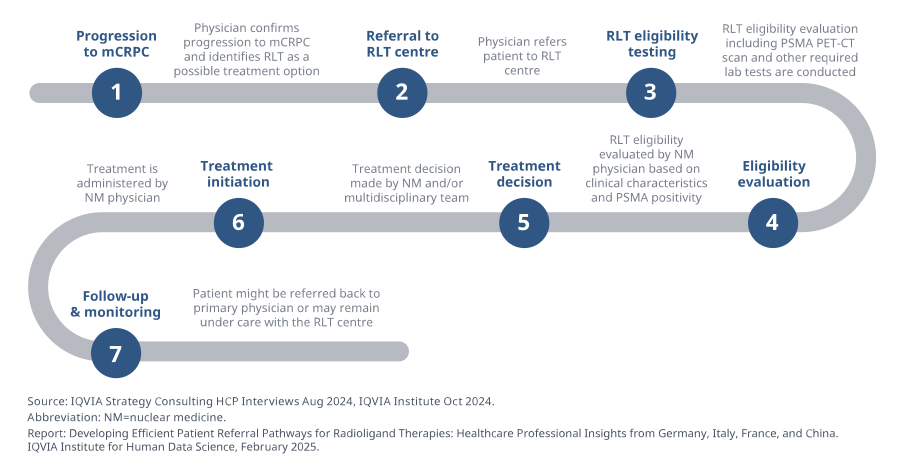
A patient’s path to RLT typically runs through seven steps, from confirming that the disease has progressed to mCRPC, through referral, eligibility testing and the treatment decision, to treatment and follow-up (shown below). The four areas of this challenge sit at different points along this pathway.
Your mission
Rethink how healthcare systems can identify, refer and guide eligible patients more efficiently, ensuring timely access to Radioligand Therapy (RLT).
Why it's not simple
The referral pathway involves multiple stakeholders, diagnostic steps and healthcare settings. Delays can occur at different points, making coordination, awareness and system integration critical to improving patient access.
02_Where to innovate
We have broken this challenge down into four areas where innovation is needed. Pick one as your focus, or design a solution that bridges several.
How might we ensure every physician who may encounter an eligible patient knows when, where and how to refer them for RLT?
For a patient to reach RLT, someone has to know where to send them, but in most countries that route is not written down anywhere. It lives in individual physicians’ contacts and habits, and awareness of RLT is still uneven. As a result, access depends heavily on which physician a patient happens to see, and eligible patients can slip through simply because the route was never clear.
Why is this difficult?
Pathway visible
How might we ensure every physician who may encounter an eligible patient knows when, where and how to refer them for RLT?
For a patient to reach RLT, someone has to know where to send them, but in most countries that route is not written down anywhere. It lives in individual physicians’ contacts and habits, and awareness of RLT is still uneven. As a result, access depends heavily on which physician a patient happens to see, and eligible patients can slip through simply because the route was never clear.
Why is this difficult?
03_ Boundaries
System constraints
These are fixed by regulation, clinical protocol or national policy. Design around them, not against them.
Ready to participate?
Submission is open from 14 September to 23 October 2026.
Q&A
Can't find what you're looking for? Write to info.oncohackathon@lspraxis.com.