Challenge 02 · PROSTATE CANCER

How can we optimize patient referrals for Radioligand Therapy in prostate cancer?

Radioligand Therapy represents a breakthrough in metastatic prostate cancer treatment, yet many eligible patients face significant delays in accessing it. Rethink how the referral journey can be accelerated to improve patient outcomes.

2nd

most diagnosed cancer in men worldwide

1.4M to 2.9M

Annual cases projection from 2020 to 2040

Ref. GLOBOCAN 2022 · Bray F. et al., CA Cancer J Clin. 2024

01_ Context

Why the referral pathway matters

While many patients respond well to surgery, radiotherapy or hormone therapy, some eventually develop metastatic castration-resistant prostate cancer (mCRPC), an advanced stage of disease with limited treatment options.

Radioligand Therapy (RLT) is changing the treatment landscape for these patients. By combining a targeting molecule with a radioactive isotope, RLT delivers radiation directly to cancer cells while minimising damage to healthy tissue.

Whether a patient is suitable for RLT is confirmed with a specialised scan called a PSMA PET-CT. RLT works by seeking out a protein called PSMA, which is commonly found on the surface of prostate cancer cells, and delivering its radiation there; the PSMA PET-CT scan looks for that same protein, and so shows whether a patient’s cancer is likely to respond and whether they are eligible for treatment.

Today, many eligible patients do not receive RLT at the optimal time, not because the treatment does not exist, but because healthcare systems struggle to identify, refer and coordinate patients efficiently. As demand for RLT grows across Europe, improving how patients move through the system has become just as important as developing new therapies.

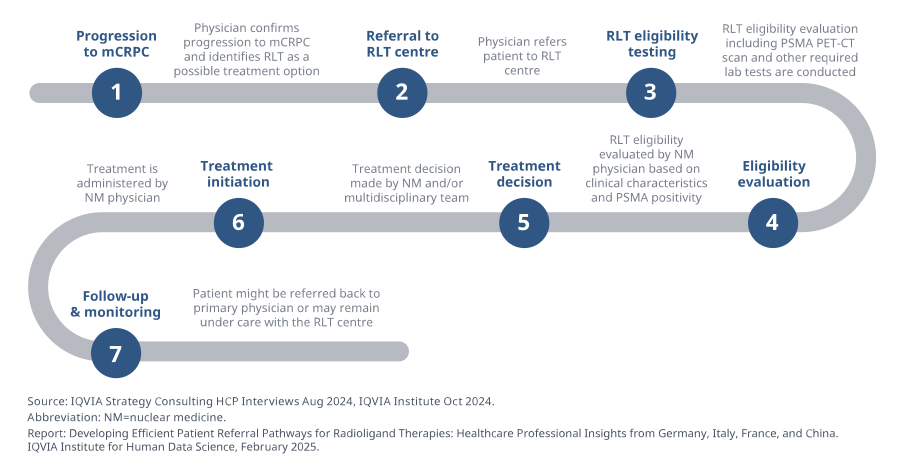
A patient’s path to RLT typically runs through seven steps — from confirming that the disease has progressed to mCRPC, through referral, eligibility testing and the treatment decision, to treatment and follow-up (shown below). The four areas of this challenge sit at different points along this pathway.
Your mission

Rethink how healthcare systems can identify, refer and guide eligible patients more efficiently, ensuring timely access to Radioligand Therapy (RLT).

Why it's not simple

The referral pathway involves multiple stakeholders, diagnostic steps and healthcare settings. Delays can occur at different points, making coordination, awareness and system integration critical to improving patient access.

02_Where to innovate

Four focus areas

We have broken this challenge down into four areas where innovation is needed. Pick one as your focus, or design a solution that bridges several.

How might we ensure every physician who may encounter an eligible patient knows when, where and how to refer them for RLT? 

For a patient to reach RLT, someone has to know where to send them — but in most countries that route is not written down anywhere. It lives in individual physicians’ contacts and habits, and awareness of RLT is still uneven. As a result, access depends heavily on which physician a patient happens to see, and eligible patients can slip through simply because the route was never clear.

Why is this difficult?

  • No agreed national or international standard for RLT referral yet exists to fall back on.
  • Contact-based referral is hard to make consistent or to scale.
  • As a newer therapy, RLT is unfamiliar to many physicians, especially outside specialist centres.
  • Patients are rarely aware RLT exists, so they cannot prompt a referral themselves.

Pathway visible

How might we ensure every physician who may encounter an eligible patient knows when, where and how to refer them for RLT? 

For a patient to reach RLT, someone has to know where to send them — but in most countries that route is not written down anywhere. It lives in individual physicians’ contacts and habits, and awareness of RLT is still uneven. As a result, access depends heavily on which physician a patient happens to see, and eligible patients can slip through simply because the route was never clear.

Why is this difficult?

  • No agreed national or international standard for RLT referral yet exists to fall back on.
  • Contact-based referral is hard to make consistent or to scale.
  • As a newer therapy, RLT is unfamiliar to many physicians, especially outside specialist centres.
  • Patients are rarely aware RLT exists, so they cannot prompt a referral themselves.

03_ Boundaries

Out of scope

System constraints

These are fixed by regulation, clinical protocol or national policy — design around them, not against them.

  • Building new imaging or treatment infrastructure — new Nuclear Medicine facilities, additional authorised RLT centres, scanners or treatment beds.
  • Tracer and radiopharmacy supply, including the short half-life of the radioligand.
  • Regulatory and patient-release frameworks, including radiation-protection and licensing rules for how RLT is administered.
  • Increasing the supply of specialised Nuclear Medicine physicians, radiopharmacists or technologists.
  • Changing national reimbursement or drug-pricing policy.

Ready to participate?

Your idea could change cancer care.

Submission is open from 7 September to 23 October 2026.

Q&A

Frequently asked questions

Can't find what you're looking for? Write to hola@hackaton.com

Who can participate?

MBA students currently enrolled in one of the five partner universities, as well as recent MBA graduates from these institutions.

Yes. While we recommend participating as part of a team, you are welcome to submit your idea individually. If your idea is selected, we will help you build a team by connecting you with other registered participants

Yes. Teams can include participants from different partner universities.

Yes. You are welcome to submit as many ideas as you wish, including ideas for both challenge statements.

If you are submitting multiple ideas as part of a team, we recommend that each idea has a different team leader to ensure each project receives the appropriate focus and representation.

The hackathon is a one-day intensive experience, running approximately from 9:00 AM to 6:00 PM.

Depending on where you are travelling from, your outbound journey may be arranged for the day before the event, and your return journey for the day after. Eligible travel and accommodation costs will be covered by the organisers.

Every meaningful innovation starts with an idea. Your proposal has the potential to improve the lives of people living with cancer and contribute to a stronger healthcare system.

Following the hackathon, the Novartis team will review all the solutions developed. Ideas with the greatest potential may be explored further, with the possibility of continued collaboration and future development beyond the event.

Please note that Novartis will own the intellectual property and commercialization rights of all ideas developed during the hackathon.

The program includes:

  • Round-trip transportation to Basel.
  • Hotel accommodation (room only).
  • Meals provided during the hackathon.

Participants are responsible for any additional hotel charges, local transportation (such as taxis), and other personal expenses.

The official language of the hackathon is English. All workshops, mentoring sessions, presentations, and team discussions will be conducted in English.

For this reason, participants should be comfortable communicating and collaborating in English throughout the event.

If you have any questions or need further information, please contact the organizing team by emailing LSpraxis.com/hackathononcology.

GET INSPIRED

Great innovations often start small

Explore projects, ideas and stories from the innovation ecosystem. Discover how simple ideas have become solutions creating meaningful impact.